
A Full Service Promotional Company for Out-of-Service Musicians
I SHOULD HAVE STAYED DEAD: THE DEATH AND LIFE OF ALLEN LOWE: A DOCUMENTARY
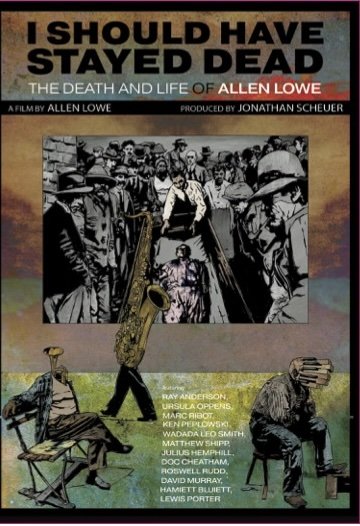
Documentary film now on DVD and Blu-ray
Soundtrack on ESP Disk
I Should Have Stayed Dead: The Death and Life of Allen Lowe is a documentary about saxophonist and American music historian Allen Lowe, whom John Szwed had called “a genius” comparable to Thelonious Monk and James Joyce, and of whom critic David Hajdu has said “his work taken as a whole is a monumental achievement. There's no one better alive.”
The saxophonist and composer Anthony Braxton has said:
“Allen Lowe is an American master...Allen Lowe is a great writer. Allen Lowe is one of the few musicians doing anything new today. He is the tradition.”
A cancer survivor who has had 25 operations post-cancer, Lowe has continued, through his illness and recovery, to record over 8 compact discs for ESP DISK, with such people as Mark Ribot, Wadada Leo Smith, Kresten Osgood, Jeppe Zeeberg, Mab Shipp, Ken Peplowski, Lewis Porter, Frank Lacy, Loren Schoenbeg, and many others. He has also written, during this time, three books on American music.
In prior years Lowe recorded a series of projects with Julius Hemphill, Roswell Rudd, David Murray, and Doc Cheatham.
The documentary, produced by Jonathan Scheuer and directed and shaped by Allen Lowe, discusses Lowe’s completely unique approach to composition and playing.
It discusses Lowe’s complicated surgeries and recovery (half of his nose was removed in 2021) and has interviews with the doctor who performed operations on his face and saved his life. It also features an interview with the legendary American music writer Greil Marcus, who has said:
“Allen Lowe has made a crucial contribution to American culture, and all those who want to see our musical history whole are in his debt”
From Su Terry, saxophonist and author of Music and the 7 Hermetic Principles, about the documentary I Should Have Stayed Dead: The Death and Life of Allen Lowe:
I am stunned by this film. On multiple levels. And where the hell did (Allen Lowe) find these young cats?!?
Films about jazz music and jazz musicians run the gamut from Enlightenment to Cringe. Being that the word "gamut" originally referred to the collection of recognized musical notes, it's an especially appropriate reference for a film about the remarkably eclectic musician and composer Allen Lowe.
Like the rest of Lowe's public work–his books, his recordings, his commentaries–I have no doubt that his new film I Should Have Stayed Dead: The Death and Life of Allen Lowe will amass both devotees and detractors. That's as it should be. Because this man doesn't give a rat's ass what anyone else thinks. He writes what he believes, he plays what he believes, and now he's filmed what he believes. Such an approach, in our oh-so-politically correct world, is as refreshing as it is rare.
A highly-respected jazz historian, author and musician, Lowe is an artist of contrasts: A white Jewish 21st century male writing about Black music from 100 years ago. A free player who jumps back inside any time he wants (or is it the other way around). A composer who assembles players of all generations to actualize his compositions which are as informed by contemporary Rock and the Avant Garde as they are by Louis Armstrong, Son House and Bessie Smith.
Yet even though Lowe's music runs the gamut, there is indeed a thread that ties everything together. The film shows how the trail started for him as a teenaged professional saxophonist, marking the stops along the way of his strange journey toward musical freedom.
Yes, he's run the gamut, and he's also run the gauntlet. From "who's Allen Lowe" to "get me Allen Lowe" to "don't mention his name in my office," to surviving and recovering from two surgeries whose aftermaths could be candidates for the Chamber of Horrors at Madame Tussauds. But no matter what happens he keeps running toward the music, and like Forrest Gump, he's joined by a diverse crew of talented colleagues who run alongside him. In I Should Have Stayed Dead we get to go behind the scenes, joining Lowe in the studio with young, unknown phenoms like Colson Jimenez, Ethan Kogan and Esteban Castro, as well as legends like Wadada Leo Smith, Marc Ribot, Roswell Rudd, Ursula Oppens (renowned in the classical world), Ken Peplowski and Julius Hemphill, and also VIP players like Frank Lacy, Loren Schoenberg, Lewis Porter and Aaron Johnson.
Since this is a film, we must mention the visuals. In the opening credits we see that this is called an "Improvised Film." The normal documentary shots are therefore augmented by historical footage of legendary musicians, various nods to Postmodernism, and spliced scenes that could have been borrowed from foreign 1960s art films. All this–plus commentary from Lowe's wife Helen Ward, writer Larry Blumenthal and others, and a plethora of music both live and in the studio–add to the strangeness of the journey.
Sometimes when we watch a movie we identify with the main character. If you identify with Lowe, good luck with that. I can't imagine being him. But I'm glad he exists. We need him to exist. Because without him and all the world's iconoclasts the rest of us would not have the courage to–once in a while–challenge the system, go against the grain, do something from the heart that makes absolutely no sense to the brain.
Remember this when you watch I Should Have Stayed Dead. It will be on the test.